
Planning a wedding involves coordinating guest lists, budgets, vendor deadlines, RSVPs, seating arrangements, and day-of logistics, which is why many couples turn to digital platforms to keep everything organized.
Options range from familiar free services to an all-in-one wedding planning tool that brings several planning functions together in one place.
Some platforms focus heavily on wedding websites and registries, while others prioritize guest management, budgeting, checklists, or customization.
The right choice depends on the size and complexity of the wedding, the features a couple values most, and whether they prefer an established wedding marketplace or a more focused planning workspace.
What to Look for in a Wedding Planning Tool
Wedding planning platforms can vary significantly in scope, so it helps to compare them using a consistent set of criteria.
Important features may include guest list management, RSVP tracking, budgeting, planning checklists, seating charts, wedding website functionality, mobile access, and collaboration between partners or family members.
Some couples may also want vendor management tools, registry integration, or the ability to organize multiple wedding-related events.
Below is an overview of several popular approaches and the features they offer.
The Knot Wedding Planner
The Knot is one of the best-known wedding planning platforms and offers a broad collection of tools within its wider wedding marketplace.
Its planning features include customizable checklists based on the wedding date, guest list management, budgeting tools, wedding websites, and access to a large vendor directory.
The platform can be particularly useful for couples who want planning tools and vendor discovery in the same ecosystem.
Because marketplace and vendor services are closely integrated into the platform, couples who prefer a planning environment without shopping or vendor recommendations may want to compare it with more standalone options.
Overall, The Knot provides a broad set of tools for couples looking for an established wedding planning platform with a large range of supporting resources.
Zola Wedding Planner
Zola combines wedding planning tools with wedding websites, registries, invitations, and other wedding-related services.
Its website builder allows couples to share event details, accommodation information, schedules, and RSVP options with guests.
The platform also includes guest list management, checklists, and budgeting features.
One of Zola’s distinguishing characteristics is its close integration with its registry and wedding marketplace. That can be convenient for couples who want several services under one account, although those primarily looking for planning tools may not need every part of the ecosystem.
Zola is therefore worth considering for couples who place particular importance on their wedding website and registry alongside their planning tools.
Joy Wedding App
Joy focuses heavily on wedding websites, guest communication, and RSVP management.
Couples can create a wedding website containing event information, travel details, schedules, and other information for guests. Its RSVP system can also support multiple events, which may be useful for weddings that include welcome parties, rehearsal dinners, ceremonies, and receptions.
Guest management features allow couples to organize attendees and collect information such as meal preferences and event attendance.
Joy also offers planning-related functionality while maintaining a relatively streamlined approach compared with platforms built around large vendor marketplaces.
Couples who require more detailed vendor, contract, or financial management may want to compare its features with platforms designed around broader project management.
AlmostWed
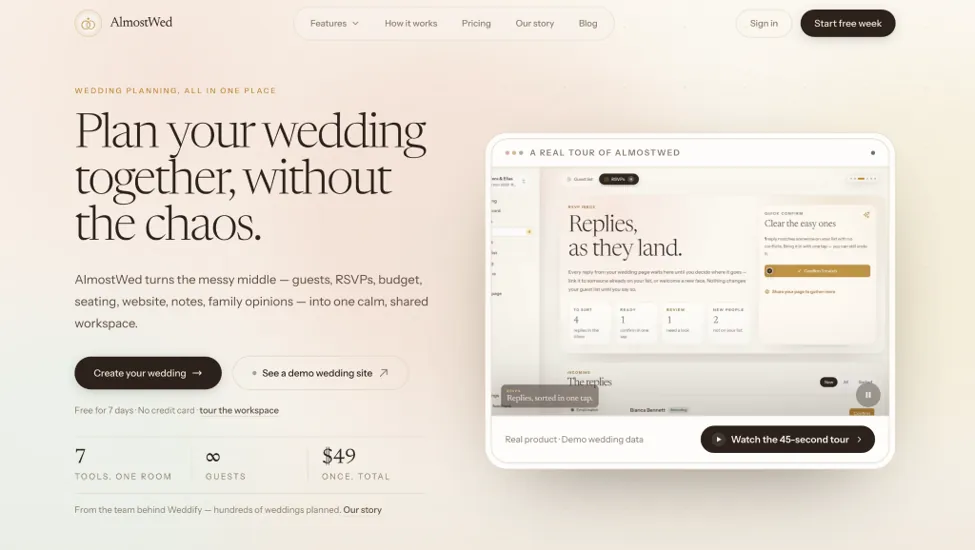
AlmostWed takes a consolidated approach by bringing several common wedding planning functions into a shared workspace.
Its features include guest and RSVP management, budgeting, planning checklists, seating arrangements, timeline tools, and wedding website functionality.
The platform organizes guest information in a way designed to accommodate households and groups, which can be helpful when managing couples, families, and plus-ones.
It also provides tools for tracking wedding expenses and organizing seating arrangements visually.
Compared with platforms that combine planning with large vendor or retail marketplaces, AlmostWed is more focused on the organizational side of wedding planning.
That approach may appeal to couples who prefer to manage several planning tasks from one dashboard rather than combining separate spreadsheets, websites, and planning apps.
As with any platform, couples should review its current features and pricing directly before deciding whether it fits their requirements.
The DIY Route: Notion and Google Sheets
Dedicated wedding planning software is not the only option.
Some couples choose to build their own planning system using Notion, Google Sheets, or a combination of productivity tools.
The biggest advantage is flexibility.
A spreadsheet can be customized with specific budget categories, formulas, payment schedules, guest information, and vendor details.
Notion can also be configured to manage checklists, timelines, inspiration boards, and databases.
The trade-off is that couples are responsible for building and maintaining the system themselves.
Features such as RSVP collection, wedding websites, automated guest communication, and visual seating charts may require additional tools or manual work.
For couples who already use spreadsheets or productivity software extensively, this approach can provide considerable control.
Those who prefer a ready-made system may find dedicated wedding planning platforms more convenient.
Why Consolidation Can Be Useful
One factor worth considering is how many separate tools will be needed throughout the planning process.
Using one service for guest information, another for budgeting, a third for seating plans, and separate documents for vendor information can make it harder to maintain a single up-to-date view of the wedding.
A consolidated platform can reduce the amount of information spread across different systems.
At the same time, not every couple needs an all-in-one solution. Someone who already has an effective budgeting spreadsheet, for example, may only need a strong RSVP and wedding website platform.
The most practical setup is usually the one that matches the couple’s existing habits and the complexity of the event.
Comparing Wedding Planning Tools
Each option takes a somewhat different approach.
The Knot combines planning tools with a large wedding vendor marketplace, while Zola integrates planning closely with websites, registries, and wedding shopping.
Joy places particular emphasis on wedding websites, guest communication, and RSVP management.
AlmostWed focuses on bringing multiple organizational tools into a single planning workspace without relying as heavily on a wider marketplace.
Notion and Google Sheets, meanwhile, provide the greatest flexibility but require couples to create and maintain their own system.
Before choosing a platform, couples may want to compare the features they expect to use most frequently, check current pricing or free-plan limitations, and consider how easily both partners can keep the information updated.
The most useful wedding planning tool is ultimately one that reduces administrative work and provides a clear place to keep important information throughout the planning process.